2026 World Cup + Sex Trafficking
As the start of the 2026 FIFA World Cup in DFW comes closer, you’re probably hearing about the intersectionality of the World Cup and sex trafficking. Some of that talk is true, some isn’t, but most of it (in our opinion) is coming from people with good intentions, trying to make sense of and be prepared for what is about to unfold in DFW as 4 million visitors head to North Texas this summer.
As an organization with boots on the ground in DFW for over 10 years (and internationally prior to that), we wanted to join the conversation in hopes of providing you with basic truth through which you can filter all other information. If you want to know the non-sensationalized truth, reading this is the best place to start.
AN HONEST DISCLAIMER
While we and other organizations are doing our best to anticipate how the World Cup will impact trafficking, the truth is that this is about to be a huge learning curve for all of us. The last time America hosted the World Cup was in 1994 - before trafficking was even legally defined by the TVPA in 2000!
We do not have a cookie-cutter response to replicate.
Of course, we can look to similar events for an idea of what to expect (e.g., Super Bowl, Olympics, World Cups hosted internationally), but DFW specifically has not hosted a sporting event in recent years that has attracted this level of local and international interest. This means that from a crisis-response perspective, part of our planned strategy is leaving plenty of room for unplanned, quick pivots as we learn the needs in real-time.
Our hope is to share with you all what we learn and experience, whether that’s real-time snapshots of what we’re seeing or a broader look a few months out once we’ve had a chance to assess data comprehensively.
THE PROBLEM
Human trafficking happens every day in communities across the nation. It is happening at this moment, it will happen during the World Cup, and it will happen after the World Cup.
Human trafficking is highlighted strongly during major sporting events because sporting events increase demand and vulnerability in areas where demand and vulnerability already exist. The World Cup is expected to bring increased tourism (4 million visitors) and disposable income to North Texas. Both of these factors impact demand for trafficked victims to be exploited.
There will also be an increased level of anonymity due to the large crowd and high number of events and activities. Anonymity reduces the risk for both traffickers and buyers, AND increases vulnerability for victims by potentially making it harder for the community to recognize instances of trafficking in the midst of the activity.
Bottom line: Sex trafficking in DFW is an existing problem that is amplified for a specific time during the World Cup.
Now that we know the problem, what’s the solution?
THE SOLUTION
Collaborate. Respond.
Act.
Empower.
COLLABORATE
Good news! Rescue Her already does this. In fact, it’s one of our core values.
We cannot do this work as a single organization. We must actively look for the good in others, partner creatively, and stay humble enough to be challenged and changed. Collaboration is how we stay accountable, grow, and expand what's possible for survivors.
Collaboration leading up to the World Cup has looked like:
Sharing our six years of motel outreach experience with a local organization that wants to equip motels near the games
Strategizing with emergency housing agencies to help increase their capacity to house the anticipated increase of victims.
Strategizing with our local and federal law enforcement partners to intervene in trafficking situations specific to the World Cup
We know from experience that meaningful victim support happens when communities, service providers, and public agencies work together, not only during major events, but everyday to create safer environments for vulnerable individuals and pathways towards support.
CRISIS RESPONSE
During the World Cup, Rescue Her will continue to provide the same consistent and effective crisis response across DFW for adult, female victims of trafficking.
Crisis services look like:
Connecting survivors to emergency medical attention and/or law enforcement intervention
Providing emotional support
Locating safe shelter
Meeting basic needs (such as food, clothing, hygiene items, sensory items to assist in trauma responses)
Providing transportation when applicable and safe
Educating survivors on their legal rights
The main difference between our normal crisis response and our World Cup Response?
Thanks to our collaboration with partner agency Rescue Hill, we are officially expanding our crisis response hours to serve victims 24/7, just in time for the World Cup.
Although this expansion of hours has been in the works for almost two years, we intentionally moved up the launch date to the start of the World Cup so we could provide vital advocacy services alongside our law enforcement partners who are working strategically to crack down on demand and support survivors.
TAKE ACTION
What is your role as a community member? We recommend two things: Become aware, then ACT.
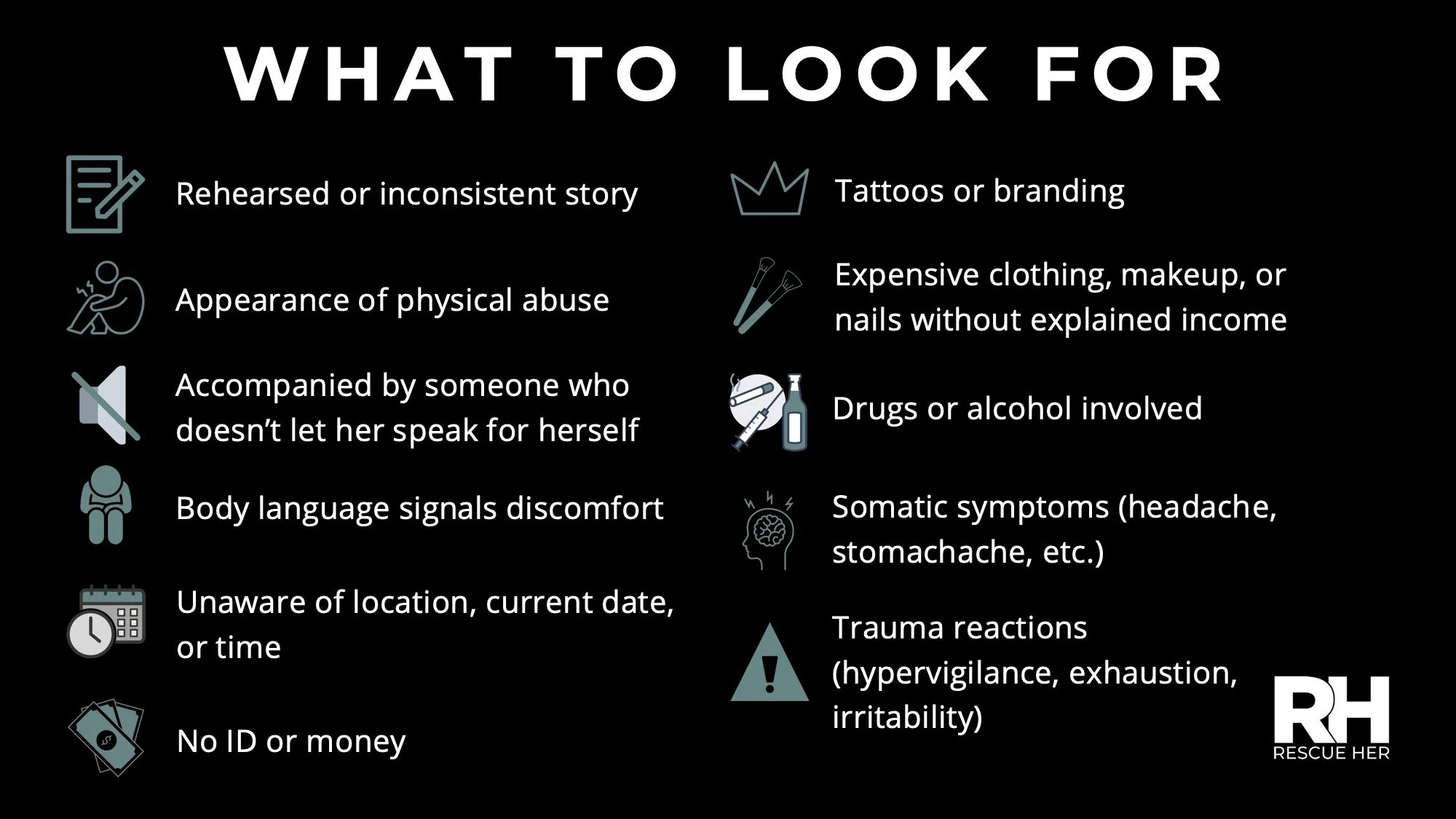
IF YOU SEE SOMETHING, SAY SOMETHING.
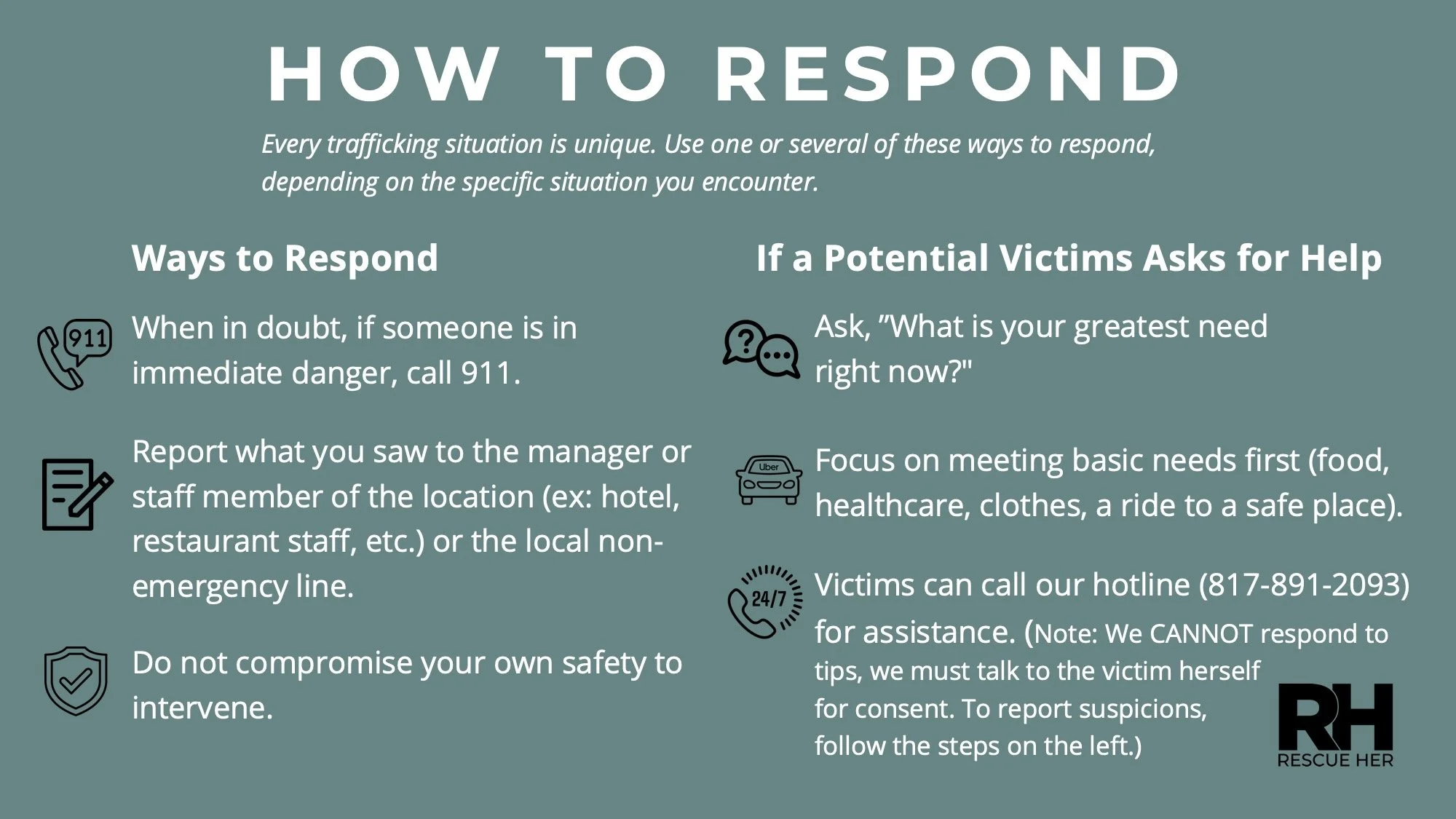
Save the graphics below so you know the basic signs of trafficking to look for, and the initial first steps of how to report.
Remember, trafficking is a complex issue and this is just a small snapshot of potential indicators and how to respond.
EMPOWER SURVIVORS
Our hope is that the World Cup is an opportunity for human trafficking awareness to be raised in a way that leads to communities empowering survivors long-term, not just during this 39-day tournament.
Here are a few practical ways to support survivors in DFW during the World Cup and year-round:
Build a Hope Kit. Shop our Amazon wishlist for Gift Cards and Hope Kit items. Each survivor we respond to on our crisis line gets a Hope Kit full of basic items within the first 72 hours of care.
Fund safe housing for survivors. Download the Safe Night App, choose Rescue Her for your organization, and you’ll get real-time notifications for how to fund short-term hotel stays for crisis survivors when emergency shelters are full.
Donate towards Basic Needs. A donation of $40 meets an initial basic need for one survivor in crisis (such as a meal, a set of clothes, a hygiene set, or other similar needs). Donate here and write “Basic Needs” in the memo line.
Donate a Car. Our team uses staff vehicles to safely transport survivors to key services (e.g., shelters, medical appointments, etc.) Due to our team growing, and one of our vehicles breaking down, we currently need two additional staff vehicles to ensure our team can transport survivors. If you’d like to help, fill out our contact form or call our office line at 817-885-9716 and we’ll be in touch.
Pray With Us. We will continue to send out bi-weekly prayer emails with relevant prayer points. Sign up here.
Raise Awareness. Share this email with someone you know so others can be accurately informed about the intersectionality between sex trafficking and the World Cup.
Remember, while human trafficking is a complex, serious, and violent crime that happens in our communities, you do NOT have to face it with ignorance or fear. We hope this helped you grow a little more confident and equipped in how to raise accurate awareness, report potential situations, and support survivors that Rescue Her empowers through our crisis response.